Summary: One result here is solid and two are not. Writing a specific to-do list before lights-out cut sleep onset latency from 25.09 minutes to 15.82 in a 57-person polysomnography study. The gratitude-and-sleep link rests on a single self-reported sub-study with a null result beside it in the same paper. Expressive writing for rumination rests on a 42-person self-report pilot whose authors called it preliminary. The shared-mechanism story you usually see attached to all three has not been tested.
The Baylor to-do list study
The most cited study on journaling and sleep comes from Scullin et al. (2018) at Baylor University, published in the Journal of Experimental Psychology: General.
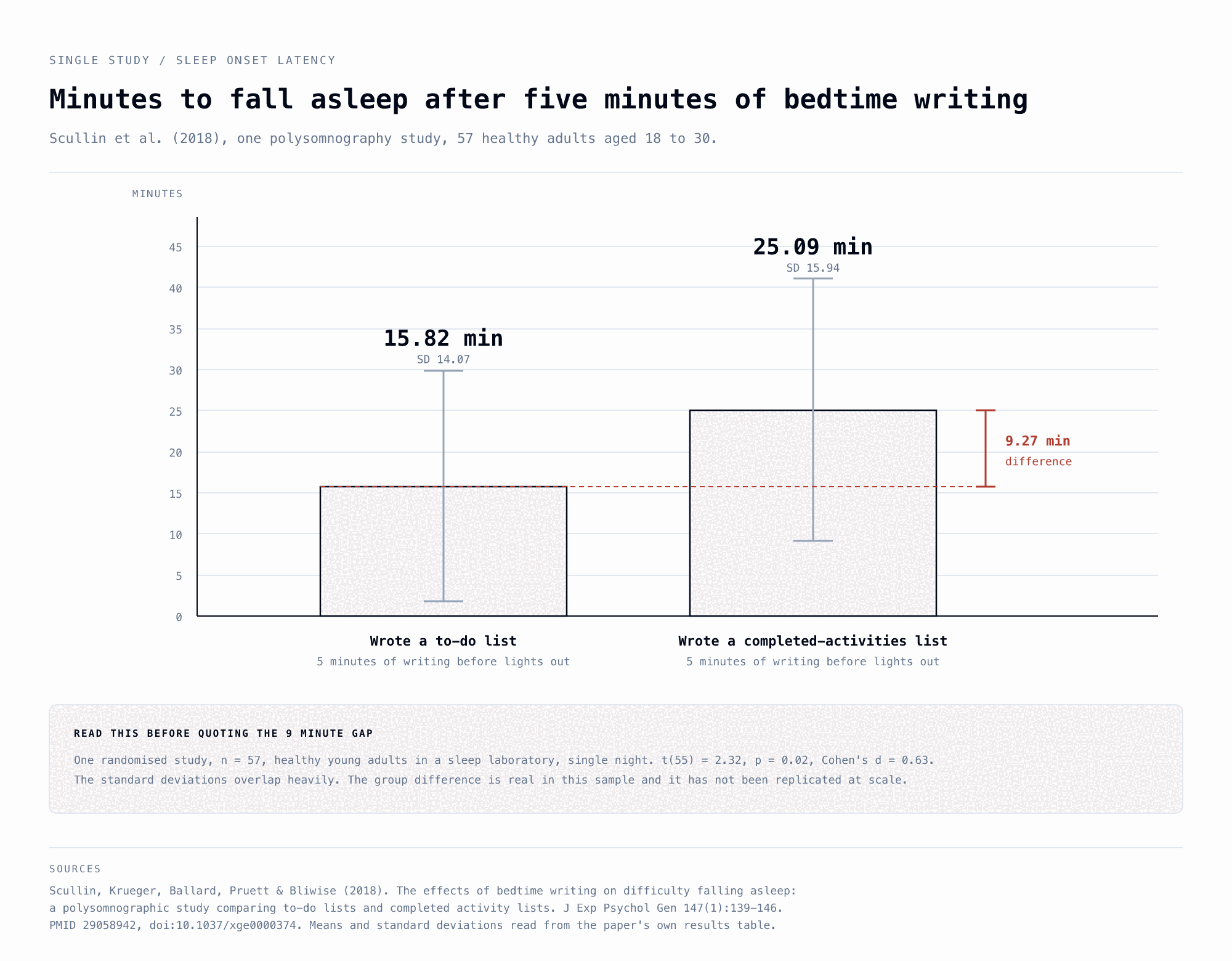
The whiskers are the point. The standard deviations are larger than the difference between the conditions, so this is one small study showing a real but noisy effect, not a settled result.
The setup: 57 healthy adults aged 18 to 30 spent a night in a sleep lab. Half were asked to write a to-do list of tasks they needed to complete in the next few days. The other half wrote about tasks they had already completed. Both groups wrote for 5 minutes before lights-out.
The result: the to-do list group fell asleep 9 minutes faster. Sleep onset latency was 15.82 minutes against 25.09, measured by polysomnography rather than self-report, t(55) = 2.32, p = .02, d = 0.63.
Read the spread alongside the means. The standard deviations were 14.07 and 15.94 minutes, comparable in size to the gap itself, which is normal for a group of this size and a reminder that this describes a difference between two averages, not a result every individual got.
Note the population. These were healthy young adults with no sleep disorder, and even the slower group averaged under 30 minutes to fall asleep. This is not a study of insomnia.
Two details matter:
-
Specificity helped. Participants who wrote more specific, detailed to-do lists fell asleep faster than those who wrote vague ones. "Email Sarah about the Q3 report" beats "work stuff."
-
Writing about completed tasks didn't help. The comparison group, who reflected on what they'd already done, showed no improvement. This isn't about reflection or gratitude. It's about offloading the open loops your brain is trying to hold.
Why 9 minutes matters
Nine minutes sounds small. Two pieces of context, and one caution.
A meta-analysis of 31 polysomnographic randomised drug trials covering 3,820 participants put the pooled effect of sleep medication on objective sleep onset latency at g = -0.36. Scullin's writing effect was d = 0.63. That comparison is not apples to apples: the drug figure pools many trials in people with diagnosed primary insomnia, and Scullin is one night with 57 healthy volunteers. But it does mean a 5-minute writing task is not obviously the weaker lever.
The to-do list exercise takes 5 minutes, has no side effects, and costs nothing.
The caution: this was measured once, in one lab, in people who did not have a sleep problem. Nobody has shown it holds up over weeks, or in insomnia.
Gratitude journaling and sleep quality
The connection is thinner than it is usually reported, and it is worth stating precisely.
Emmons & McCullough (2003) ran three studies. Only one of them found a sleep effect. In Study 3, 65 adults with neuromuscular disease kept a daily gratitude record for 21 days; the gratitude group reported 7.58 hours of sleep against 7.06, and rated themselves more refreshed on waking. Both differences were significant at p < .05.
Study 2, which used a daily gratitude record with students, explicitly found no difference in sleep amount or quality between conditions. So the founding gratitude study produced one positive sleep result in a chronically ill sample and one null in a healthy one.
The proposed mechanism: gratitude journaling displaces pre-sleep negative cognition. A systematic review of pre-sleep cognitive activity in adults covers what is known about the link between that activity and sleep onset latency, and what happens when you manipulate it.
A 2023 meta-analysis of 64 randomised trials found gratitude interventions produced better mental health and fewer anxiety and depression symptoms. It did not measure sleep. The link to sleep here is inference, not a pooled result.
The honest summary: gratitude-and-sleep rests on self-reported sleep in one sub-study. The Baylor to-do list result is far stronger evidence, because it used polysomnography.
Expressive writing and rumination
The third pathway is Pennebaker-style expressive writing. This targets a different sleep problem: not the planning mind, but the ruminating mind.
People with insomnia often report intrusive thoughts: replaying conversations, re-experiencing stressful events, anticipating worst cases.
The evidence that expressive writing fixes this is weaker than the popular version. Smyth, Hockemeyer & Tulloch (2008) randomised 25 people with diagnosed PTSD to write about their trauma or about time management. PTSD symptoms did not change. What did change: mood improved, and cortisol response to trauma-related memories was sharply attenuated. The authors' own framing is that patients kept the core features of PTSD but their capacity to regulate the response improved. Read that as a physiological arousal result, not a symptom cure, and note the sample was 25 people.
Harvey & Farrell (2003) tested the writing idea directly on sleep. Forty-two poor sleepers were assigned for 3 nights to write about worries and concerns, to write about hobbies, or not to write. The worries group reported shorter sleep onset latency than the no-writing group. This was a pilot, the outcome was self-reported rather than polysomnographic, and the authors describe it as highlighting potential rather than establishing efficacy.
Three problems, three tools
| Sleep problem | What helps | Evidence behind it |
|---|---|---|
| Can't stop planning tomorrow | To-do list (5 min) | Strongest: one polysomnography RCT, d = 0.63, healthy young adults |
| Negative mood / anxiety at bedtime | Gratitude journaling | Weakest: one self-reported sub-study in a chronically ill sample, and a null beside it |
| Rumination / intrusive thoughts | Writing about worries | Middling: one 42-person pilot with self-reported sleep onset |
If you want a single routine, do the to-do list, because that is the tested one. Adding a gratitude line and a sentence about what is bothering you costs about a minute and follows the two weaker leads. Treat those two as worth trying, not as things known to work.
Voice journaling before bed
Writing before bed means screens. Screens mean blue light, stimulation, and the temptation to check email. This is a real problem for sleep hygiene.
Voice journaling sidesteps it:
- Lights off. You can do a voice brain dump in the dark, in bed, with your phone face-down.
- Speed. Ruan et al. (2018) measured speech-to-text at 153 words per minute against 52 for a phone keyboard. A 60-second voice entry is about 150 words; 5 minutes of typing is about 260. Voice is faster per minute, not more total content in a fraction of the time.
- Low friction. You're already in bed. Picking up a pen or opening a laptop adds activation energy. Speaking doesn't.
None of that is evidence that a spoken version reproduces Scullin's result. The participants in that study wrote by hand, and no one has run the comparison. The script below applies the tested content in an untested medium, which is a reasonable thing to try and not a finding.
A bedtime voice script:
- Tomorrow's tasks: list what's on your mind for tomorrow (the Baylor approach)
- One gratitude: one specific thing from today (the Emmons approach)
- One sentence about what's bothering you: name it, don't solve it (the Pennebaker approach)
Tag it [bedtime] and you have a searchable sleep journal.
What doesn't work
Unstructured venting about stressful topics right before bed. This one is a caution rather than a finding. The only cited work that bears on it is the Lemyre et al. (2020) review, which surveyed attempts to manipulate pre-sleep cognitive activity and concluded the effects are "either beneficial, negligible, or detrimental," with the mechanisms unresolved. So the honest statement is that open-ended emotional writing at bedtime has an unknown direction, and the one bedtime task that has been measured, Scullin's to-do list, worked precisely because it was specific and bounded. Prefer the bounded version because it is the one that was tested, not because venting has been shown to backfire.
Screens. If you're journaling on your phone with the screen bright, you're offsetting much of the benefit. Use voice, use a physical notebook, or at minimum use night mode.
Expecting a cure for clinical insomnia. These are supplements to sleep hygiene, not replacements for CBT-I (cognitive behavioral therapy for insomnia), which remains the gold standard for chronic sleep problems.
Related: