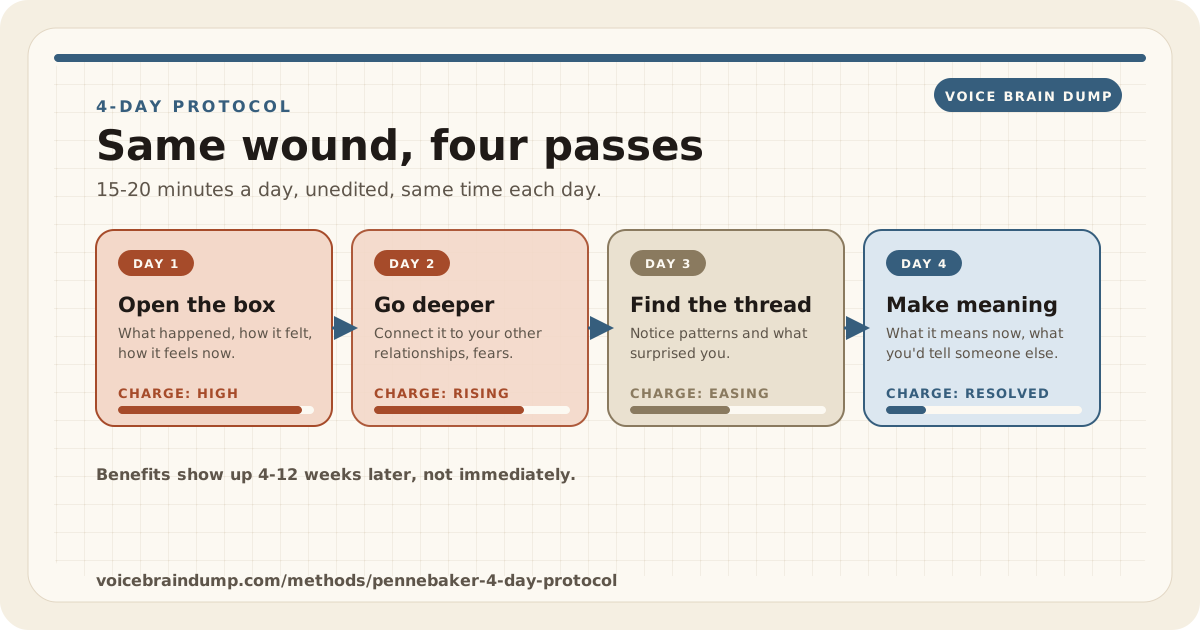
Summary: Write about your deepest emotions for 15 to 20 minutes a day, 4 days in a row. Don't edit, don't stop, go deep. This is the most-studied journaling method in psychology, and the pooled effect is small: r = .075 across 146 randomised studies.
Before you start
Pick your topic. Choose an experience that still carries emotional weight. It doesn't have to be the worst thing that ever happened to you, just something unresolved.
Good topics:
- A relationship that ended badly
- A career failure or regret
- A loss you haven't fully processed
- A conflict with someone important
- A fear or anxiety you keep circling
Pick your medium. Handwriting, typing, or voice. All work. The key constraint is: continuous expression without stopping to edit.
Pick your time. Same time each day if possible. Many people do it in the evening. Don't do it right before sleep if the topic is heavy: give yourself 30+ minutes to decompress. What actually helps and backfires for bedtime journaling is more specific than "journal in the evening."
Day 1: Open the box
Set a timer for 15 minutes (minimum) to 20 minutes.
Start writing or speaking. Don't plan what you'll say. Start with the first thing that comes to mind about the experience and follow it.
Rules for all 4 days:
- Don't stop writing/speaking until the timer ends
- Don't go back and fix anything
- Don't worry about grammar, structure, or making sense
- Nobody will read this but you (and they don't have to read it at all)
- If you run out of things to say, repeat what you just said until something new comes
What you're writing about:
- What happened
- How you felt then
- How you feel about it now
- What you haven't told anyone
After Day 1: You may feel emotional, drained, or unsettled. That is what the research records. Smyth's 1998 synthesis found that writing increased immediate distress, and that the distress was unrelated to health outcomes. So the discomfort is expected, and there is no evidence that it is the mechanism.
Day 2: Go deeper
Same setup. Timer. Same topic (recommended) or a new one.
Today, expand outward:
- How does this experience connect to other parts of your life?
- How did it shape your relationships?
- What does it say about who you are or who you're becoming?
- What are you afraid of?
You'll start noticing things you didn't see on Day 1. The second pass reveals the subtext.
Day 3: Find the thread
By Day 3, a narrative is forming whether you intended it or not. Your brain is doing the work of organizing, which is the entire point.
Today, write about:
- What patterns you've noticed
- What surprised you in the first two days
- What you've been avoiding saying
- What this experience taught you (even if the lesson was painful)
Nobody has published a day-by-day phenomenology of this protocol, so treat any "by Day 3 you will feel" script, including one you read on this site before today, as invention. The one measured four-day pattern comes from Murray and Segal (1994): how painful the topic felt fell steadily across the four days, while negative emotion rose after every single session.
Day 4: Make meaning
This is the last day. Write about:
- What this experience means to you now
- What you've learned from writing about it
- What you would tell someone going through the same thing
- Anything that feels unfinished: say it today
End however feels right. There's no required conclusion. Some people feel resolved. Some feel lighter. Some just feel done.
After the 4 days
Don't reread immediately. Let it sit. The processing happens in the weeks after, not during.
Don't wait for a delivery date. No trial establishes when benefits appear, or that they appear for any given person. The 4 to 12 week window often attached to this protocol comes from a single trial, Wong et al. (2018), which assessed psychotherapy clients "about 4 weeks as well as 12 weeks after the conclusion of the writing intervention". That is a measurement schedule, not a latency, and in that trial the arm using Pennebaker's instructions did not differ significantly from control. The gratitude-writing arm was the one that improved.
You can repeat it. If another difficult experience comes up months later, run the protocol again. It's not a one-time thing. It's a tool you can use whenever needed.
You can destroy what you wrote. Seriously. The value is in the writing, not the document. Some people delete or burn their entries. That's fine. The processing already happened.
Adapting this for voice
If you're doing this by voice instead of writing:
- Set the same timer (15–20 minutes)
- Speak continuously: the voice equivalent of "don't stop writing"
- Don't replay the recording, at least not the same day
- Walk while you speak if you find it easier. Nothing in this literature has tested movement during disclosure, so this is a convenience, not an ingredient
- Use a private recording setup, you need to feel safe to go deep
What is actually known about speaking versus writing: Murray and Segal (1994) ran 20-minute vocal and written sessions over the same 4-day structure and found "similar emotional processing" in both, with no winner. Their content analysis suggested greater overt expression of emotion in the vocal condition. That is one small 1994 study with no health follow-up, and nothing since has repeated it. The claim that voice is harder to self-censor is a plausible reading of that content analysis, not a finding.
When to not do this
- If you're currently in acute crisis, work with a therapist first
- If the topic involves active trauma (not past events), get professional support
- If you feel significantly worse after Day 2 (not just uncomfortable, genuinely destabilized), stop and seek support
- If you're using this to replace therapy, reconsider: they work well together, but this isn't therapy
The evidence
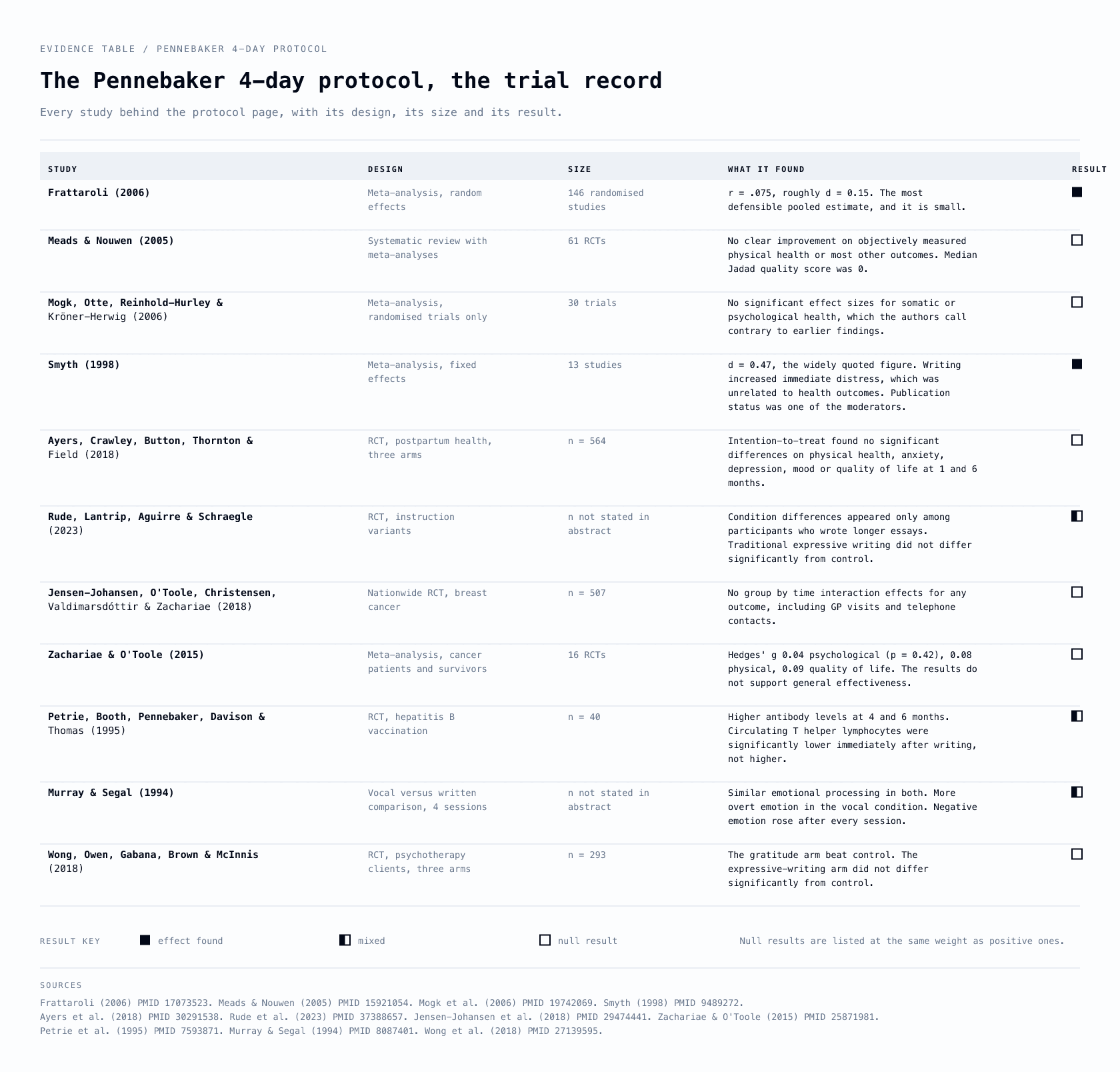
This is the most-studied journaling method in psychology. The pooled effect is small, and it gets smaller as trial quality rises. Here is every paper behind that sentence, with what each one actually reports.
| Study | Design | What it found | What it does not show |
|---|---|---|---|
| Frattaroli 2006 | 146 randomised studies, random effects | Positive and significant, average r = .075, roughly d = 0.15 | A clinically meaningful effect for any individual. This is the best estimate available and it is small |
| Smyth 1998 | 13 studies, fixed effects | The source of the famous d = 0.47. Writing also increased immediate distress, unrelated to outcomes | Generalisation beyond its 13 studies. Its own moderator list includes publication status |
| Meads and Nouwen 2005 | 61 RCTs, health-technology-appraisal method | "No clear improvement for emotional disclosure compared with controls in objectively measured physical health and most other outcomes." Median Jadad quality score of the trials: 0 | Nothing. This is the counterweight |
| Mogk et al. 2006 | 30 randomised trials pooled | "Neither regarding somatic nor psychological health variables significant effect sizes were found", described by the authors as contrary to earlier findings | That the paradigm is worthless, only that restricting to randomised designs erases the effect |
| Ayers et al. 2018 | n = 564, three arms, postpartum women | Intention-to-treat: no significant differences on physical health, anxiety, depression, mood or quality of life at 1 and 6 months. Uptake and adherence were low | A failure of the method in high-risk subgroups, which the authors ask for next |
| Rude et al. 2023 | Three arms, traditional vs acceptance-enhanced vs control | Differences appeared only among participants who wrote longer essays, and traditional expressive writing "did not differ significantly from control" | A main effect for either version. It is a moderator finding |
| Murray and Segal 1994 | Vocal vs written, 20 minutes, 4 days | "Similar emotional processing" in both. Painfulness of the topic fell across the 4 days; negative emotion rose after every session | That voice is equal to writing for health. It measured emotional processing, not outcomes at follow-up |
Four claims this page used to make, and what the papers say
- "Reduced doctor visits." Jensen-Johansen et al. (2018) randomised 507 Danish breast-cancer patients nationwide and reported "no group by time interaction effects for any outcomes", healthcare utilisation included.
- "Improved immune function (T-cell activity)." No trial in this literature reports that. The immune result people mean is Petrie et al. (1995): 40 medical students, higher hepatitis B antibody levels at 4 and 6 months, and circulating T helper lymphocytes significantly lower immediately after writing. One vaccine, one small trial, and the T-cell direction is the opposite of the claim.
- "Works for chronic illness." Zachariae and O'Toole (2015) pooled 16 randomised trials in cancer patients and survivors: Hedges' g 0.04 psychological (p = 0.42), 0.08 physical, 0.09 quality of life. "Our results do not support the general effectiveness of EWI in cancer patients and survivors."
- "Effects persist for months." No source. Deleted.
Four days of writing costs nothing but a bad hour on day one, which is a fine reason to try it. It is not a reason to expect a transformation, and any page that promises one is not reading its own citations.
See what the evidence really shows about the Pennebaker protocol for the full breakdown.
Try it by voice: Brain Dump: speak for 15 minutes, get a Markdown transcript. On-device, private, no cloud upload during capture.
Related:
- the research behind expressive writing: the underlying science
- how Huberman, Oprah, and others journal
- voice journaling scripts for iPhone: prompts to speak instead of write