Summary: Write about your deepest thoughts and feelings for 15–20 minutes, 4 days in a row. That's the entire protocol. It has been tested in hundreds of studies, and the honest bottom line is: many studies, small pooled effect (r = .075 across 146 randomised trials), and the effect shrinks or disappears in the reviews that restrict themselves to good trials. Andrew Huberman called it the most evidence-backed journaling method he had encountered, which is a statement about the volume of research, not the size of the benefit.
What is the Pennebaker Protocol?
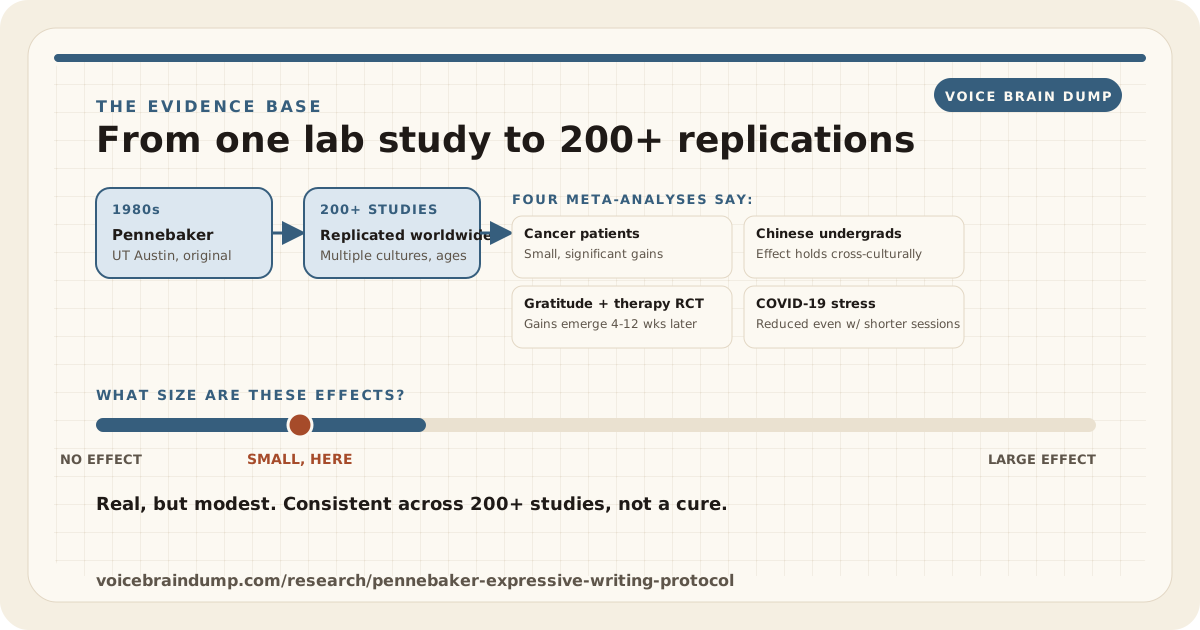
In the 1980s, psychologist James Pennebaker at the University of Texas at Austin ran a simple experiment: he asked people to write about their most traumatic or emotionally significant experiences for 15–20 minutes a day, four days in a row.
The control group wrote about neutral topics: what they did that day, what they ate.
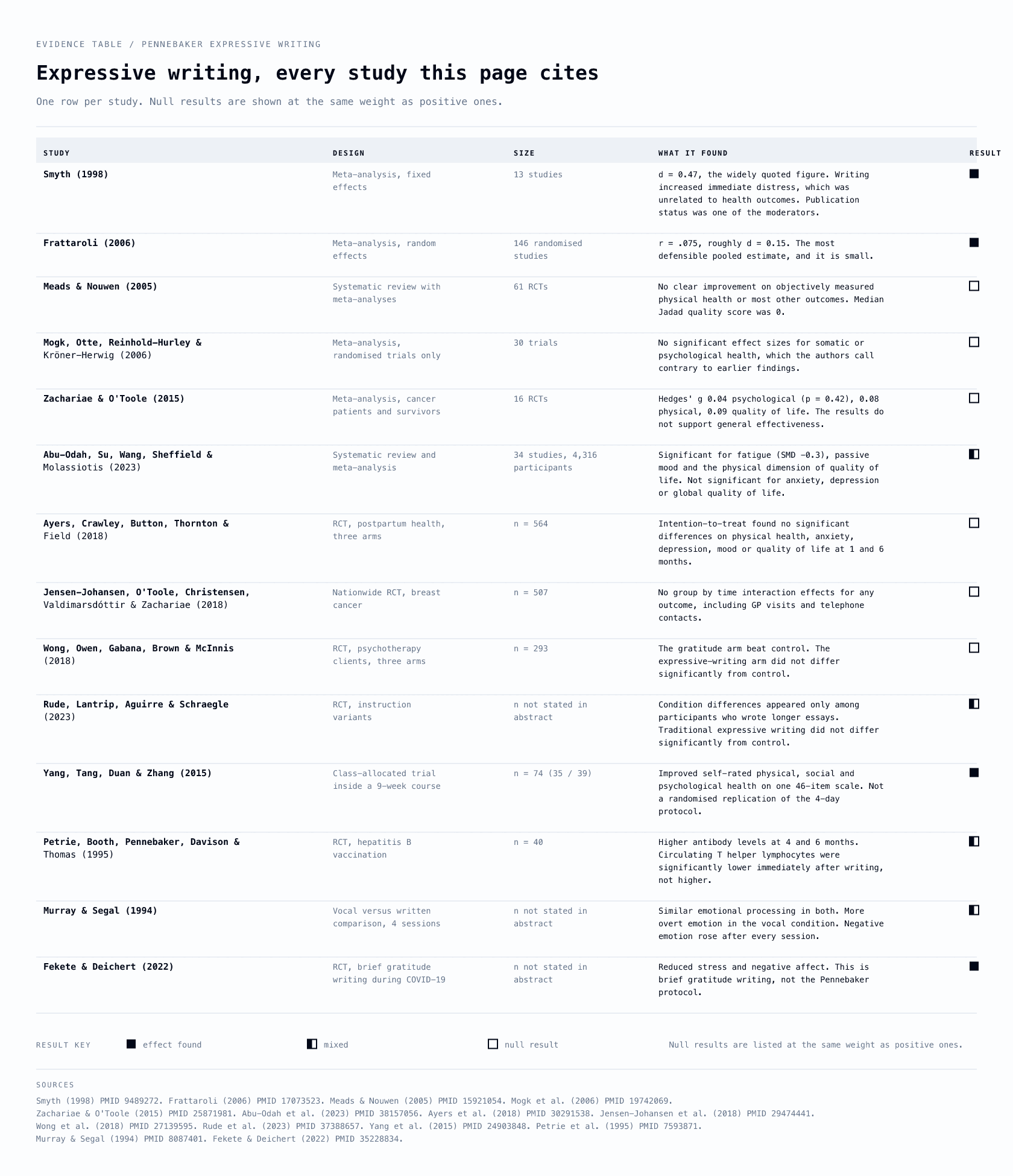
Early results looked striking, and they are quoted far more loosely than they were reported. The best known physical finding is Petrie et al. (1995): 40 medical students, randomly assigned to write about trauma or control topics for four days, then vaccinated against hepatitis B. The writing group showed significantly higher antibody levels at the 4 and 6 month follow-ups. That is one vaccine in one small trial. The same paper reports that circulating T helper lymphocytes were significantly lower in the writing group immediately after writing, which is the opposite of the "improved T-cell activity" line that circulates online, including on this site until today.
The "fewer doctor visits" claim has not held up either. Jensen-Johansen et al. (2018) randomised 507 Danish women treated for breast cancer, nationwide, and found "no group by time interaction effects for any outcomes", healthcare utilisation included.
Pennebaker and his students replicated and extended the paradigm, and hundreds of researchers picked it up. The honest way to state the volume is not a podcast's study count: Frattaroli's 2006 meta-analysis alone collected 146 randomised studies, and its pooled effect is r = .075.
What the meta-analyses say
Individual studies can be noisy. Meta-analyses, studies of studies, give a clearer picture.
The number to lead with. Frattaroli's 2006 meta-analysis pooled 146 randomised studies under a random-effects model and reported r = .075, roughly d = 0.15. That is the most defensible estimate of the effect available, and it is small. The widely quoted d = 0.47 comes from Smyth's 1998 analysis of 13 studies under a fixed-effects model, which does not generalise beyond the studies it included.
The counterweight. Meads & Nouwen (2005) reviewed 61 randomised trials for a health-technology assessment and found "no clear improvement for emotional disclosure compared with controls in objectively measured physical health and most other outcomes." The median Jadad quality score of the included trials was 0, meaning the typical trial in this field reported neither adequate randomisation nor blinding.
The largest clean null. Ayers et al. (2018) randomised 564 women across three arms and found no significant differences on physical health, anxiety, depression, mood or quality of life at 1 and 6 months.
Cancer and chronic illness: another null. Zachariae and O'Toole (2015) pooled 16 randomised trials in cancer patients and survivors and found nothing: Hedges' g 0.04 for psychological outcomes (p = 0.42), 0.08 physical (p = 0.22), 0.09 quality of life (p = 0.22). Their conclusion: "Our results do not support the general effectiveness of EWI in cancer patients and survivors." Abu-Odah et al. (2023) pooled 34 studies and 4,316 participants and found a significant improvement in fatigue (SMD -0.3), passive mood and the physical dimension of quality of life, but not in anxiety, depression or global quality of life. This site previously described both as condition-specific results not to be generalised. That was the wrong framing: there is no positive general result here to withhold.
The trial the "4 to 12 weeks" claim comes from. Wong et al. (2018) randomised 293 psychotherapy clients to therapy alone, therapy plus expressive writing, or therapy plus gratitude writing, and assessed them "about 4 weeks as well as 12 weeks after the conclusion of the writing intervention". Two things follow. The 4 and 12 weeks are when the researchers measured, not a delay before benefits arrive. And the gratitude arm was the one that improved: "those in the expressive and control conditions did not differ significantly." This site has cited this trial three times as evidence for expressive writing. It is evidence against it.
Outside Western samples. A study of Chinese undergraduates reported improved self-rated physical, social and psychological health. Read the design before quoting it: n = 74, allocated by class rather than by individual (35 experimental, 39 control), the writing embedded in a 9-week elective course, and one 46-item self-report scale as the only outcome. It is a promising classroom study, not a randomised replication of the 4-day protocol.
COVID-19 stress: During the pandemic, a brief gratitude writing intervention reduced stress and negative affect, with sessions shorter than Pennebaker's 15-minute prescription. Again, gratitude writing, not the protocol.
Why Huberman thinks this matters
Neuroscientist Andrew Huberman dedicated a full Huberman Lab episode (Nov 2023, 644K views) to the Pennebaker protocol. His summary:
"A journaling method that is supported by over 200 peer-reviewed studies in quality journals... I was frankly not aware of this journaling practice."
Huberman's key points:
- It's not daily journaling. The protocol is a focused 4-day intervention, not a habit.
- It works through emotional processing. Writing about difficult experiences forces the brain to create a coherent narrative, which reduces the emotional charge of the memory.
- The neuroscience, as he frames it: writing engages prefrontal regions involved in emotional regulation, and the brain "files" unprocessed emotions. No imaging study has scanned people doing this protocol. The nearest real evidence is the affect-labeling work, where participants silently choose an emotion word for a photograph in a scanner, which is a different task. Treat this point as Huberman's framing, not a measured mechanism.
Psychologist Dr. Ethan Kross discussed similar mechanisms with Huberman: expressive writing helps "organize chaotic thoughts, quiet negative self-talk."
The protocol (exactly what to do)
Duration: 15–20 minutes per session Sessions: 4 consecutive days Topic: Your deepest thoughts and feelings about a significant emotional experience
Rules:
- Write (or speak) continuously. Don't stop to edit, fix grammar, or organize.
- Go deep. Write about your most significant emotional experiences, not surface-level descriptions.
- Explore feelings. Connect the experience to other parts of your life: relationships, childhood, who you are, who you want to be.
- You can write about the same event all 4 days or switch. Most people go deeper on the same topic.
- Nobody reads it. This is for you. Don't write for an audience.
What to expect:
- Day 1: You may feel worse after writing. Smyth (1998) found that writing increased immediate distress, and that the distress was unrelated to health outcomes.
- Across the four days: the only measured pattern comes from Murray and Segal (1994). How painful the topic felt fell steadily day by day, while negative emotion rose after every session. Anything more specific than that, in either direction, is invention.
- Afterwards: no trial establishes when or whether benefits appear for an individual. Expect a small effect at best.
Can you do this by voice?
Pennebaker's original studies used handwriting and typing. The 4-day protocol has never been trialled by voice.
One study has ever compared the two directly. Murray and Segal (1994) ran 20-minute vocal and written sessions about traumatic events over 4 days and found "similar emotional processing was produced by vocal and written expression". Both groups ended up feeling better about the topic and about themselves. Content analysis suggested greater overt expression of emotion in the vocal condition. That is the entire head-to-head literature: one small 1994 study, measuring emotional processing rather than health at follow-up, never replicated.
Everything else said in favour of voice is an inference, and this site marks it as one:
- Speech is faster than phone typing. Whether entry speed reduces self-censorship has not been measured.
- You can speak while walking. Nothing in this literature has tested movement during disclosure.
- Speaking continuously makes editing awkward. That is a property of the medium, not a tested outcome.
If you use voice, the instruction is unchanged: don't stop, don't edit, go deep. You are running an untested variant of a method whose written version has a small pooled effect. See voice versus writing for journaling for the full comparison.
What this is not
- Not a daily habit. The Pennebaker protocol is a 4-day intervention. Repeating it months later is fine, but it's not designed as a daily practice.
- Not gratitude journaling. Gratitude journals focus on positive experiences. The Pennebaker protocol specifically targets difficult or traumatic emotions.
- Not therapy. If you're dealing with severe trauma or PTSD, work with a clinician. Expressive writing can complement therapy, but it's not a replacement.
- Not reliably better than a control condition. Rude et al. (2023) compared Pennebaker's traditional instructions, an acceptance-enhanced version, and a control. Essay length moderated everything: "Condition differences were found only for participants who wrote longer essays: For these participants the AEEW condition outperformed both control and tEW; and tEW did not differ significantly from control." So the acceptance prompt beat the standard one only among people who wrote at length, and the standard protocol did not beat the control at all in this trial. The authors' reading is that engagement explains much of the variability in this literature.
Key takeaway
The protocol has been tested more than any other journaling method, and the result is modest. Frattaroli's 146-study meta-analysis puts it at r = .075. Two reviews restricted to randomised trials found nothing on objectively measured health. A 564-person randomised trial found nothing. The papers that report larger effects tend to be the older, smaller, lower-quality ones, and Smyth's own 1998 analysis names publication status as a moderator.
That is not a reason to skip it. It is 15 minutes a day for 4 days, it costs nothing, and the downside is a bad hour on day one. It is a reason to go in expecting a small effect rather than a transformation, and to stop reading any page that promises otherwise.
You don't need a special journal, a special app, or a therapist to do this. You need 15 minutes, something to write or speak into, and the willingness to go deep.
Try it: Brain Dump lets you do this by voice: speak continuously for 15 minutes, get a Markdown transcript in your iCloud. Private by default.
Related reading: