Summary: Four meta-analyses, and they disagree in a way worth understanding. Against a no-treatment control, gratitude journaling produces a small but consistent gain, Hedges g 0.19 to 0.22, holding across cultures and ages. Against another active exercise, it shows no advantage at all, d = -0.03. So the honest claim is that writing down what went well beats doing nothing, and that nothing here says it beats any other reflective practice.
The evidence at a glance
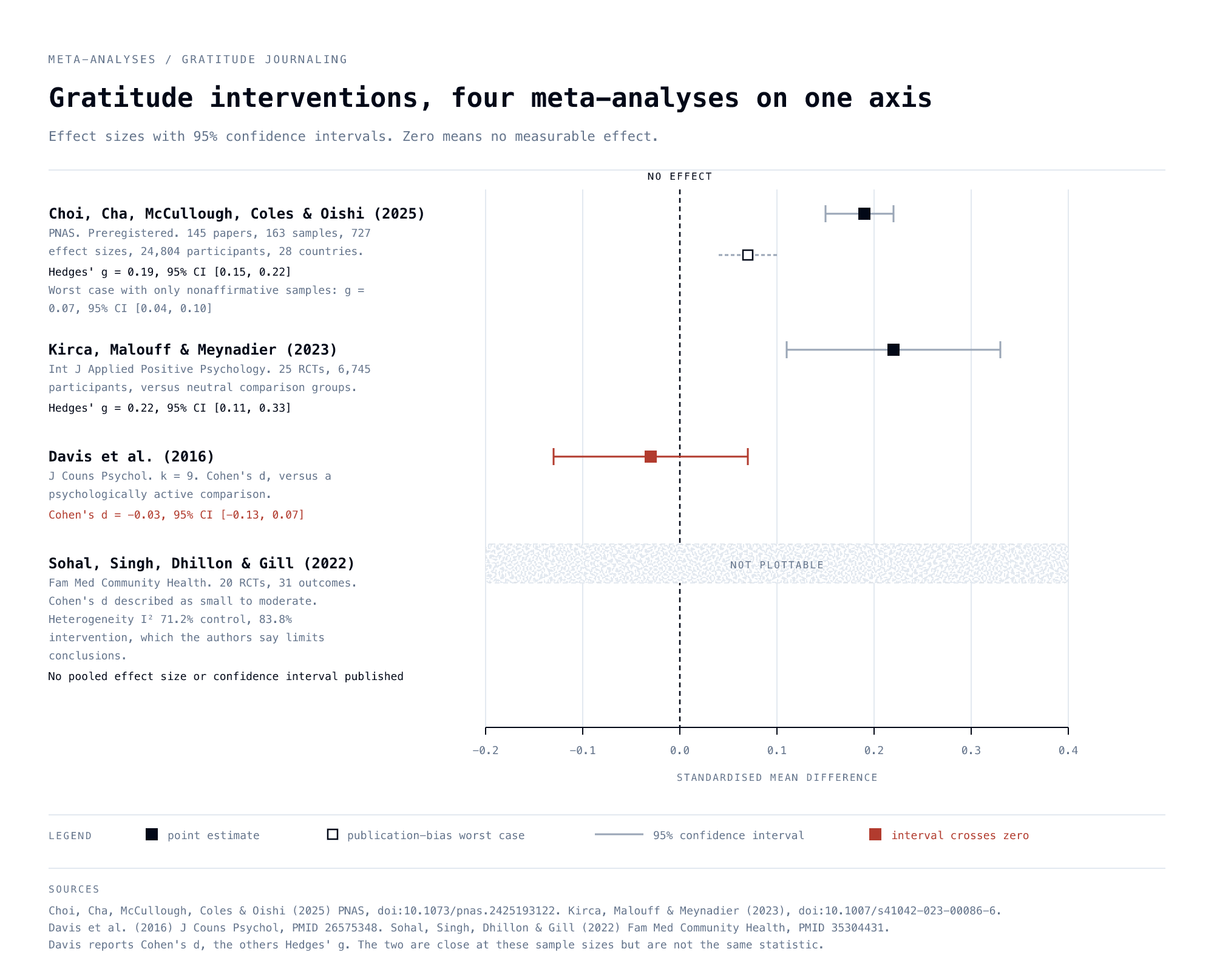
The Davis interval crossing zero is the row that matters most, and it is the one usually left out of summaries of this literature.
The meta-analyses
1. PNAS (2025): the biggest study
This meta-analysis is the most comprehensive to date:
- 145 papers, 163 samples, 727 effect sizes, across 28 countries
- 24,804 participants
- Effect size: g = 0.19, 95% CI [0.15, 0.22], on well-being
- Preregistered
An effect size of 0.19 is "small" in statistical terms. For context: exercise has an effect size of about 0.30 on depression. Gratitude journaling is smaller, but it's also a lot less effort than going to the gym.
The cross-cultural finding matters: this isn't just a Western, affluent, educated-population effect. It holds across diverse samples.
2. Einstein (Sao Paulo) (2023): 64 RCTs
This systematic review analyzed 64 randomized controlled trials and found gratitude interventions consistently reduce:
- Anxiety symptoms
- Depression symptoms
The authors concluded that gratitude practices are a viable non-pharmacological intervention for mild-to-moderate mood issues.
3. International Journal of Applied Positive Psychology (2023): life satisfaction
This meta-analysis focused specifically on "expressed gratitude" (writing or speaking, not just feeling):
- 25 RCTs, 6,745 participants
- Effect size: g = 0.22, 95% CI [0.11, 0.33], on psychological wellbeing, covering life satisfaction, positive affect and happiness
The "expressed" part matters. Thinking grateful thoughts has weaker effects than writing or speaking them. Externalization is the mechanism.
What actually works (and what doesn't)
What works:
Specificity. "I'm grateful for my family" does almost nothing. "I'm grateful my sister called me back within 5 minutes when I was spiraling." That registers. The more concrete and specific, the stronger the effect.
Consistency over frequency. 2–3 times per week is enough. Daily isn't necessary and can lead to "gratitude fatigue" where entries become rote. The key is showing up regularly, not every day.
Adding a "why." One randomised trial added gratitude writing to psychotherapy for 293 clients. The gratitude arm reported significantly better mental health than both the expressive-writing arm and the control arm. The researchers measured at about 4 and 12 weeks after the writing ended, so those numbers are a measurement schedule and not a waiting period before benefits arrive. The trial also tested gratitude writing as a whole, not the "why" prompt specifically, so treat the deeper-processing explanation as a mechanism story rather than a finding.
Brief is fine. During the COVID-19 pandemic, a brief gratitude writing intervention reduced stress and negative affect, with sessions much shorter than the typical research protocol. You don't need 20 minutes.
What doesn't work:
Generic lists. "Health, family, job" repeated daily becomes meaningless fast. If you're not noticing new things, the exercise has stopped working.
Forcing positivity. Gratitude journaling isn't about pretending everything is fine. It's about noticing small, specific things that went right, even on bad days. "The coffee was warm" is a valid entry.
Treating it as the treatment. A systematic review of 20 randomised trials of journaling for mental illness found a small-to-moderate benefit, then said the heterogeneity and methodological flaws in those trials made it impossible to draw a definitive conclusion about the size of that benefit. Its own recommendation is to use journaling as an adjunct to evidence-based care. If you're in acute distress, talk to a professional first.
The honest assessment
Gratitude journaling is not a cure-all. The effect sizes are small. It won't fix clinical depression, repair a bad relationship, or make a terrible job tolerable.
What it does:
- Shifts attention slightly toward what's working
- Creates a searchable record of good moments
- Builds a habit of noticing
- Compounds over weeks and months
The people who get the most from it treat it as a noticing practice, not a positivity exercise. The goal isn't to feel grateful. It's to pay attention.
A voice gratitude script (60 seconds)
If you want a research-informed approach that takes less than a minute:
- Three specific gratitudes: concrete, sensory, small
- One "why": for any of the three, say why it mattered today
- One repeatable action: something you'll do tomorrow because today showed you it works
Tag it [grateful] so you can search later.
See the 60-second voice gratitude script for the full walkthrough.
Related:
- the practical voice version of this script
- the Pennebaker protocol: the other major evidence-based protocol, built around expressive writing
- Oprah's 30-year gratitude practice
- the Pennebaker 4-day protocol: the step-by-step deep dive