Summary: Putting a feeling into words lowers amygdala activity and, in several studies, lowers self-reported distress. This was first shown in 2007 with participants silently selecting a written emotion word. The strongest real-world evidence for spoken labeling comes from exposure therapy studies, where saying a fear word out loud during a feared encounter measurably reduced physiological arousal. The effect is real, specific labels beat vague ones, and it has limits: it doesn't always change how upset you feel, and in low-intensity situations it can occasionally make things worse.
What the 2007 study actually did
In 2007, Matthew Lieberman and colleagues at UCLA put 30 participants (18 women, 12 men, ages 18–36) into an fMRI scanner and showed them photographs of faces displaying negative emotions. Below each face, two words appeared. In the experimental condition, participants picked the word that better matched the face: "angry" or "fearful." In the control condition, they picked a gender-matched name instead: "Harry" or "Sally."
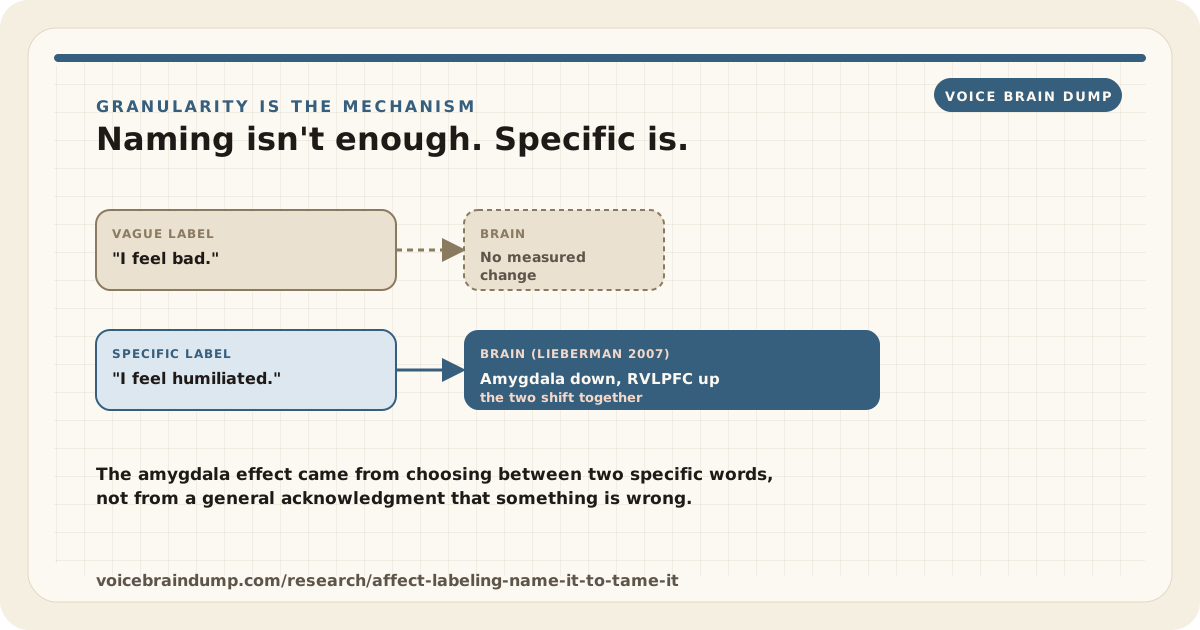
Two things changed in the brain. Amygdala activity, the structure most associated with fast, threat-relevant emotional response, went down when participants chose the emotion word. It did not go down in the name-matching control condition. At the same time, activity increased in one specific region: right ventrolateral prefrontal cortex (RVLPFC), an area linked to putting things into language and to inhibiting other responses. RVLPFC activity and amygdala activity were inversely correlated, and that relationship ran through medial prefrontal cortex. The paper's proposed mechanism: labeling recruits a prefrontal region that talks the amygdala down, the same rough circuitry used in more effortful emotion regulation like reappraisal, except this happens as a side effect of naming, not as a deliberate regulation strategy (Lieberman et al., 2007).
That last point gets confirmed later. A 2011 follow-up by the same lab found people don't actually believe affect labeling helps. Across four studies, participants who experienced lower self-reported distress after labeling an emotional picture still predicted, going forward, that labeling would make them feel worse (Lieberman et al., 2011). The benefit runs on a channel people don't have conscious access to, which is part of why it's easy to skip.
Vague labels are not the same input as specific ones
"I feel bad" and "I am anxious about the 3pm review" are not interchangeable data. The research on emotional granularity, the ability to identify and name specific, differentiated emotions rather than broad positive/negative categories, finds that people who label with more granularity handle stress better across a wide range of measures (Kashdan, Barrett & McKnight, 2015). A 2025 scoping review pulling together 98 studies found lower granularity consistently associated with mood disorders, anxiety disorders, substance use, PTSD, and other clinical conditions, across biological, developmental, and clinical measures (scoping review, 2025).
The practical read: the amygdala-calming effect in the Lieberman paradigm came from choosing between two specific emotion words, not from a general acknowledgment that something was wrong. "I feel weird" doesn't do the same work as "I feel humiliated." If a label is doing anything, it's differentiating one state from a set of others, not just registering that arousal is present.
Where speech specifically comes in
This is the part to get precise about, because it's easy to overstate.
The foundational neuroimaging studies, including Lieberman et al. (2007) and the related work comparing labeling to reappraisal and distraction (Lieberman et al., 2011), used silent, written selection: participants pressed a button to choose one of two words on a screen. No one spoke. The amygdala effect and the self-report effect were both established using this button-press paradigm. If your image of "affect labeling" is someone quietly thinking "that's anger," that's the version with the most direct fMRI evidence behind it.
Spoken labeling has been tested separately, in real clinical exposure settings, and it also works. In Kircanski, Lieberman & Craske (2012), spider-fearful participants were repeatedly exposed to a live spider. In the labeling condition, they spoke aloud during the exposure, using their own fear and anxiety words to describe what they were experiencing in the moment. A week later, that group showed reduced skin conductance response to a different spider in a different room, and the amount of fear language they used out loud during exposure was directly associated with how much their fear response dropped (Kircanski, Lieberman & Craske, 2012). Niles, Craske, Lieberman & Hur (2015) ran a similar design for public speaking anxiety: participants who verbalized affect labels during exposure showed greater reductions in physiological arousal than a no-labeling control group, and again, using more labels predicted a bigger effect.
So the honest summary: the brain-imaging evidence for the core mechanism used silent, written selection. The evidence that speaking a label aloud changes real-world fear responses comes from a smaller set of exposure-therapy studies, and in both, it's specifically self-generated spoken language, not a written checklist, that predicted the outcome. That's a real, if narrower, claim, and it's the one place in the broader journaling and emotional-processing literature where the mechanism was tested with speech rather than merely tolerated with it. A voice note where you say the specific feeling out loud, rather than recording a general vent, sits closer to the paradigm that was actually tested.
A usable protocol
You don't need a scanner or a spider to use this. The steps below compress into something you can do in under two minutes, at the moment a feeling shows up.
- Catch the moment. Before a hard conversation, mid-anxiety spike, right after a bad meeting, whenever a specific feeling is present and you have thirty seconds alone.
- Say a specific sentence out loud. Not "I feel bad." Something with an emotion word and a cause: "I am anxious about the 3pm review." "I am angry that he cancelled twice." The specificity is not decoration, it's the part the granularity research says matters.
- Layer a second feeling if there is one. "I'm angry, and underneath that I'm actually scared this project is behind." Layered labels are still specific labels.
- Stop. Don't explain why, don't problem-solve, don't try to talk yourself out of it. The label is the intervention. Nothing about the mechanism above requires follow-up analysis.
If you're recording a voice note rather than saying it to no one, the mechanics don't change: say the specific feeling and its cause out loud, in one or two sentences, and move on. This overlaps with the fourth day of the Pennebaker protocol, where you're asked to name what you feel and connect it to the rest of your life, except here the naming itself, not the narrative, is the active ingredient.
The limits
This is not a universal fix and the evidence has real edges.
It doesn't always change how you feel, only how your body responds. In the Niles (2015) public speaking study, the labeling group showed lower physiological arousal but no difference in self-reported fear. Kircanski (2012) found the same split: reduced skin conductance a week later, but no difference in self-reported fear at posttest. Two of the strongest real-world spoken-labeling studies both found this same disconnect. If you label a feeling and still say you feel just as anxious, that is a documented and normal outcome, not a sign the technique failed.
Intensity matters, and low-intensity is a place labeling can misfire. A 2022 controlled study found that affect labeling reduced distress for high-intensity aversive images, consistent with the earlier work, but increased distress when the stimulus was low-intensity (Levy-Gigi & Shamay-Tsoory, 2022). The authors explicitly flagged this as a problem for blanket advice to "name it before you react": naming a strong feeling seems to help; naming a mild one occasionally backfires.
People don't believe it works, which is itself part of the finding. Even participants who had just experienced reduced distress from labeling, in the Lieberman (2011) study, predicted that labeling would make them feel worse the next time. That mismatch between the measured effect and people's intuitions is worth knowing before you evaluate whether "it worked" based on how convinced you feel in the moment.
Naming is not resolving, and it is not the same act as ruminating. The mechanism described here is a brief act of differentiation and encoding, closer to tagging a data point than to working through it. Chewing on a feeling, replaying it, asking "why do I always feel this way," is a different cognitive activity, and none of the studies above show that repeated rumination produces the same amygdala or self-report effect as a single, specific label. If naming a feeling turns into circling it for twenty minutes, you've left the paradigm that has evidence behind it.
This is not treatment for a diagnosed condition. The exposure-therapy studies used affect labeling as one component inside a supervised clinical protocol for specific phobia and social anxiety, delivered by researchers, not as a standalone replacement for treatment. If a feeling is tied to a diagnosed anxiety disorder, PTSD, or another clinical condition, this is a technique to bring into that treatment, not a substitute for it.
Where this connects
Affect labeling is a narrower, more mechanistic claim than the general case for expressive writing. The Pennebaker 4-day protocol is about sustained writing or speaking over days; affect labeling is about the specific act of naming, and it's been tested as a component within exposure therapy, not just within writing studies. The research on Pennebaker's expressive writing protocol covers the broader evidence base that affect labeling sits inside: Memarian et al. (2017) found that how strongly someone's amygdala and prefrontal cortex responded during a lab affect-labeling task predicted how much they benefited from a separate expressive-writing intervention, directly tying the labeling mechanism to writing outcomes.
On modality, the voice vs. writing research lays out the general case that speech and text both support journaling's core mechanisms. Affect labeling is the more specific exception inside that broader picture: it's one of the few places the evidence was built using spoken output rather than merely allowing it. If you're working through something layered rather than a single named feeling, the shadow work prompts are a longer format for the same underlying idea, that naming what's underneath a reaction changes your relationship to it.
Try it by voice: Brain Dump works for a single labeling pass as well as a longer session. Say the specific feeling and its cause out loud, get a transcript, done.