Summary: Pick one life domain (career, relationships, health, a goal). Set a timer for 20 minutes. Write about that domain as if everything has gone as well as it possibly could, in concrete detail, without editing. Do it across multiple sessions, not once. A 2019 meta-analysis of 29 studies found this reliably lifts positive affect and optimism; a classroom study running it once a week for a semester found no measurable long-term gain, so the repetition matters more than any single sitting.
Where it came from
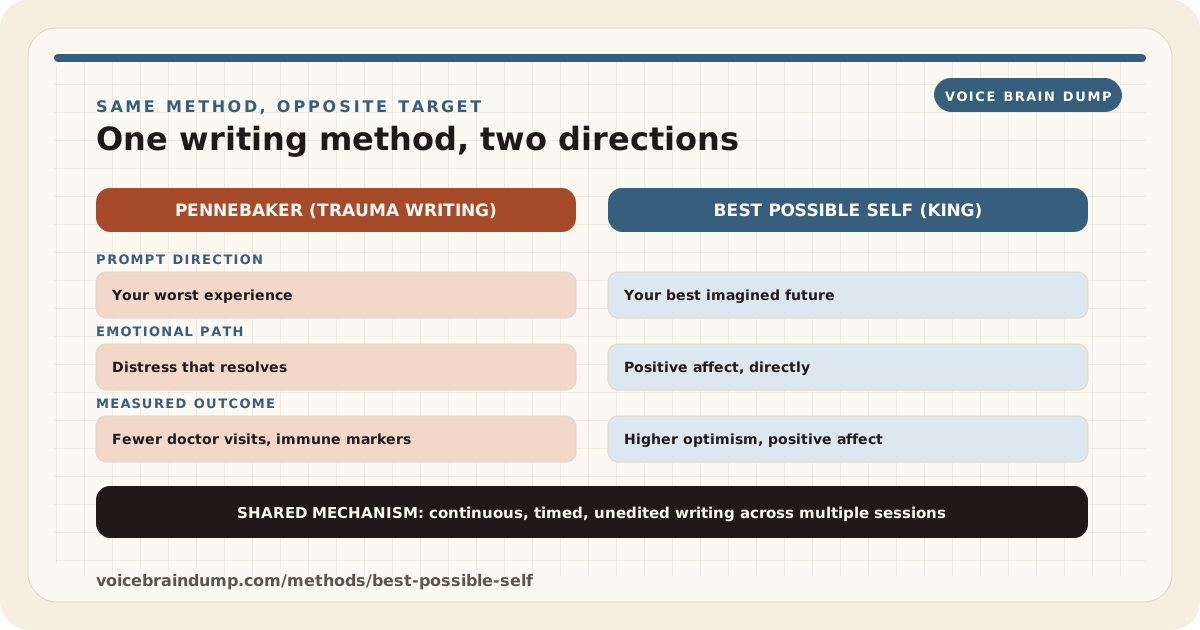
Laura King introduced Best Possible Self in a 2001 study in Personality and Social Psychology Bulletin, and she built it as the direct counterpart to Pennebaker's trauma-writing paradigm, not an unrelated exercise. Her design used 81 undergraduates split into four writing conditions: trauma alone, best possible self alone, both, or a neutral control topic, each writing 20 minutes a day for 4 consecutive days.
The mechanism is identical to Pennebaker's 4-day protocol: continuous, timed, unedited writing, repeated across several days. What King flipped was the emotional target. Pennebaker points you at your worst experience. King pointed the same writing structure at your best imagined future. King's own abstract is not indexed in PubMed or Europe PMC, and Semantic Scholar's copy has the abstract field elided by the publisher, so the specific effect sizes behind her original result cannot be independently confirmed here. What is safe to say, and is why the paper is cited at all: King designed the exercise so that writing toward a positive imagined future, not just writing toward a painful one, could be tested as a route to the same kind of downstream benefit Pennebaker's paradigm claims. The effect sizes and dosage findings on the pages below come from the later meta-analyses, not from King's paper directly.
The protocol, exact
Domain. Pick one area, not your whole life. Career, a relationship, health, or a specific goal you're chasing. King's original instructions did not specify a domain list; later studies in the Carrillo 2019 meta-analysis typically narrowed to one or two domains per session for this reason: an unbounded "best possible life" prompt produces vaguer writing than a bounded one.
The prompt. King's instructions, close to verbatim: imagine yourself in the future, after everything has gone as well as it possibly could. You have worked hard and succeeded at accomplishing your life goals. Think of this as the realization of your life dreams, in the domain you picked. Now write about what you imagine.
Duration and repetition. King used 20 minutes a day, 4 consecutive days, the same cadence as the Pennebaker protocol it was designed to mirror. The wider literature diverges from that: the Carrillo 2019 meta-analysis surveyed 29 studies with per-session lengths from 10 to 75 minutes and total practice time from 20 to 170 minutes across all sessions. The finding that matters for dosage: shorter total practice showed marginally larger effects, not longer. More minutes did not mean more benefit. Do fewer, focused sessions rather than one long marathon session.
When you stall. Don't switch to planning language ("I will accomplish X"). Stay in the imagined, already-achieved frame: describe the day-to-day texture of the outcome, not the plan to get there. If you run out of detail in one domain, that's a signal to stop that session, not to force more words, since the meta-analysis found no benefit to longer total writing.
How many sessions total. King ran 4. Studies pooled in the Carrillo meta-analysis varied widely, some using a single session, some running weekly for several weeks. The moderator analysis found no significant difference between delivery formats, individual versus group, or online versus face-to-face, but it did flag age as a marginal factor: the effect trended larger for older participants within the mostly young-adult samples these studies drew from. Read that as a caution against generalizing the exact numbers to a population the studies didn't include, not as a reason to skip the exercise if you're younger.
Speaking it instead of writing it
This site is a voice journaling app, and every study cited above used written text. Nobody has run King's protocol, or the studies in the meta-analysis, with spoken input. Treat what follows as a reasonable adaptation of the mechanism, not a claim that the evidence transfers:
- Same 20-minute timer, same single domain per session.
- Speak continuously in the present-as-if-already-true frame: "I'm sitting in the office I built, the first client contract is signed..." rather than describing a plan.
- Don't narrate that you're doing an exercise. Speak the imagined scene directly, the way you'd narrate a memory, except it hasn't happened yet.
- Repeat across separate sessions on separate days rather than one long spoken session, matching the dosage finding above.
What it's good for, and what it isn't
The Carrillo 2019 meta-analysis pooled 29 studies and 2,909 participants and found: a moderate gain in positive affect (d = .511), medium gains in wellbeing (d = .325) and optimism (d = .334), and small gains in negative affect (d = .192) and depression (d = .115). The Malouff and Schutte 2017 meta-analysis of 29 optimism-intervention studies (N=3,319, overall g = .41) found that studies using the Best Possible Self method had a substantially higher effect size (g = .64) than studies using other optimism techniques (g = .28), the largest moderator effect in the review.
Read those numbers correctly. This is a mood and optimism lift, not a treatment for clinical depression; the depression effect size is small and the researchers describe it as limiting clinical application. It is closer to what King originally found: a low-cost way to move the needle on how you feel about your future, without the acute distress of trauma writing.
It also does not hold up unconditionally outside the lab. A 2021 study ran the exercise in a real undergraduate classroom across a full semester and found no significant long-term wellbeing improvement over a control group. The abstract goes further than a null result: the control group performed better than the treatment group one month after the intervention, the opposite of what the tightly controlled meta-analyzed studies show. The gap between a short, structured lab protocol and an unstructured real-world habit is exactly where this exercise tends to fail.
Common failure modes
Writing a fantasy instead of a reachable future. King's instructions ask for a future you worked hard for and succeeded at, not a lottery-ticket scenario. If what you're writing wouldn't require any effort from present-you, you've drifted from the exercise into wish fulfillment, which the underlying studies did not test.
Being vague. "I'll be happy" is not a Best Possible Self entry. Concrete, sensory detail is what the protocol asks for and what makes it feel real enough to shift affect.
Doing it once and stopping. The classroom study above is the cautionary case: infrequent, unstructured use over months produced no measurable gain. The lab studies behind the effect sizes used repeated, close-together sessions.
Using it to avoid a problem that needs the opposite exercise. If what's actually on your mind is unresolved grief, a conflict, or a loss, that calls for Pennebaker's trauma-focused protocol, not this one. Best Possible Self is not a substitute for processing something that's still raw; King designed it as a separate tool for a separate purpose.
Try it by voice: Brain Dump can capture a 20-minute spoken session and turn it into a transcript you can revisit, on-device, without a cloud upload during capture.
Related:
- The Pennebaker 4-day writing protocol, the trauma-focused counterpart this exercise was designed against
- Fear-setting: Tim Ferriss's journaling exercise for making hard decisions, a different structured exercise for decisions you're avoiding
- Morning Pages, a daily, undirected practice rather than a domain-specific one
- Morning voice journal prompts for a lighter daily entry point