Summary: Traditional journaling asks people with ADHD to do the things ADHD makes hardest: maintain a habit, sit still, and hold a thought long enough to write it down. Voice journaling flips the equation. You speak at the speed of thought, need zero setup, and capture ideas before working memory drops them.
The problem with "just journal"
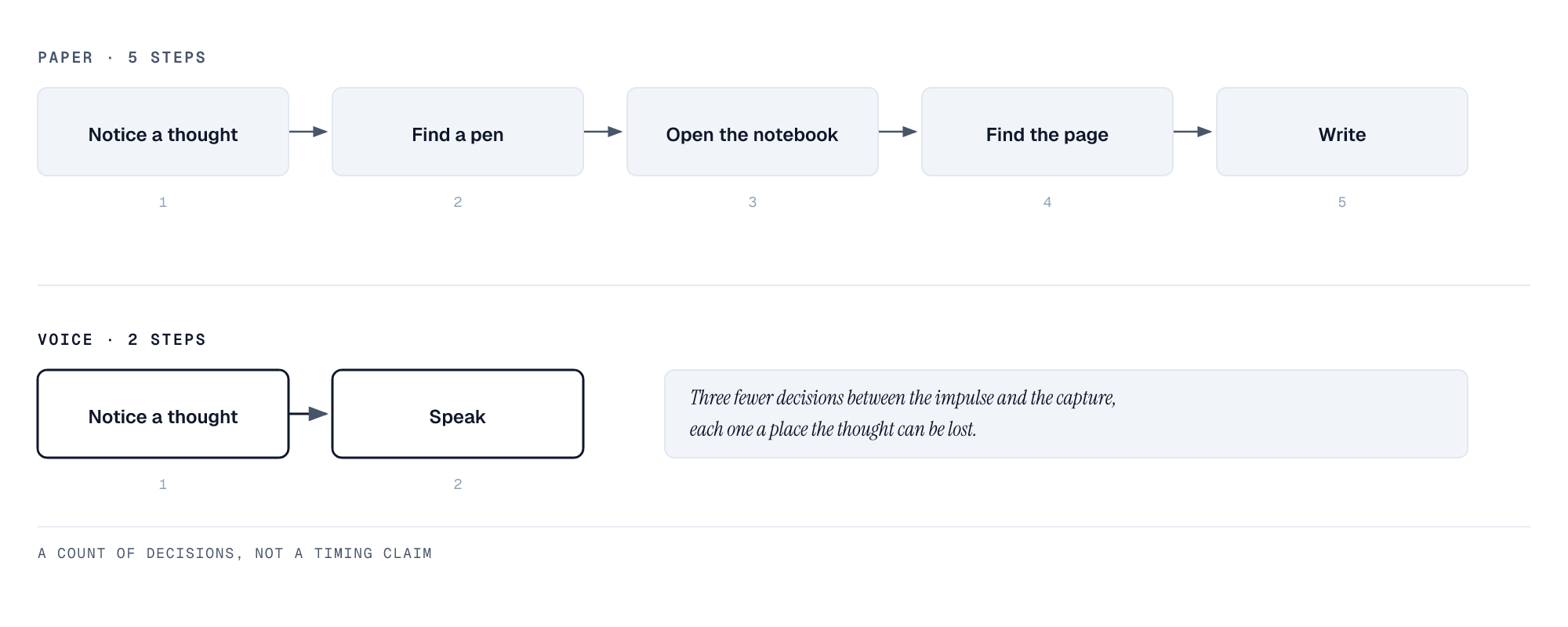
That diagram counts decisions, not seconds. Each step is a place where the thought can be lost.
If you spend any time on r/ADHD, you'll find dozens of threads that follow the same pattern:
Someone buys a good notebook, writes in it for a few days, and finds it on a shelf months later. Someone knows journaling would help and still cannot start, because the thought is gone by the time the pen is found. Someone has restarted the habit a dozen times and never lasted past a week.
These are paraphrases of a recurring pattern, not quotations from any one post. The pattern is what matters, and it is not a willpower problem. It's a friction problem, and ADHD amplifies friction exponentially.
Three specific ADHD traits make traditional journaling fail:
1. Working memory drops thoughts fast
Dr. Russell Barkley, the most cited ADHD researcher alive, describes ADHD as fundamentally a deficit in executive function, not attention. Working memory is one of the core executive functions affected.
The practical result: you have a thought worth capturing. You reach for your journal. You find a pen. You open to the right page. By the time you're ready to write, the thought is gone, or it's a fragment of what it was.
Speech is faster than typing, and faster still than handwriting. A controlled lab study of 32 people on an iPhone 6 Plus measured speech input at 153 words per minute against 53 for the on-screen keyboard, roughly 3 times faster. Handwriting is slower than typing again. For someone whose working-memory buffer is smaller than average, that gap decides whether the thought survives long enough to be recorded.
2. The habit doesn't stick
ADHD brains struggle with routines that don't have immediate external reinforcement. Journaling is private, delayed-reward, and invisible to others. It's the exact profile of a habit that ADHD makes hard to maintain.
People on r/ADHD report cycling through journaling methods:
The described cycle is always the same: try Bullet Journal, then Morning Pages, then a gratitude journal, then a handful of apps. Each one is exciting for a few days and then forgotten entirely.
This is textbook ADHD: the novelty wears off, there's no external accountability, and the habit dies.
3. Blank pages trigger paralysis
Choice paralysis is a documented ADHD symptom. A blank page is infinite choice. What do I write about? How much? In what format? For many people with ADHD, the open-endedness of journaling is the problem, not the solution.
Barkley's key insight: externalize everything
Russell Barkley's most practical recommendation for managing ADHD comes down to one word: externalize.
In Taking Charge of Adult ADHD, he writes that ADHD is not a knowledge problem: people with ADHD usually know what they should do. It's a performance problem: they can't reliably do it in the moment.
The solution: don't rely on internal systems. Put information outside your head. Lists, reminders, timers, sticky notes: anything that offloads working memory to the environment.
Voice journaling is externalization in its purest form. You think a thing. You say the thing. It's now outside your head, transcribed, and searchable. No intermediate steps. No friction.
How people with ADHD use voice journaling
Based on Reddit threads, ADHD forums, and clinical reports, here are the patterns that actually work:
The "parking lot" brain dump
When a thought hits, any thought, any time, open voice and speak it. Don't wait for the "right time." Don't save it for your evening journal session. Capture it now, in 10 seconds, and move on.
People with ADHD report that this single change, capturing in the moment instead of scheduling journaling time, makes the difference between a practice that sticks and one that dies.
Body doubling with your phone
Body doubling is an ADHD coping strategy where the presence of another person helps you stay on task. You're not interacting with them, they're just there. It works because ADHD brains respond to external social cues.
Voice journaling has a mild body-doubling effect: you're speaking to something. The act of talking, even to your phone, creates a subtle sense of accountability that thinking alone doesn't. People describe the difference in the same terms: writing in a journal feels impossible, but talking to a phone feels like telling someone about the day, and that is enough to start.
Structured prompts, not blank pages
Instead of "journal about your day," use a script:
- What's on my mind right now? (30 seconds, just dump it)
- What's the one thing I need to do next? (externalize the priority)
- How am I feeling, in one word? (emotional check-in without analysis paralysis)
Total time: 60 seconds. No decisions about format. No blank page.
Don't aim for daily
The ADHD journaling advice that actually works isn't "journal every day." It's:
- Make it so easy you can't say no (voice, 30 seconds, no setup)
- When you remember, do it immediately (don't schedule: capture the impulse)
- Forgive the gaps (missed a week? Start again. No guilt, no "catching up")
Consistency for ADHD doesn't mean every day. It means every time the impulse arises, the friction is low enough to act on it.
What the research says (and doesn't)
There's limited research on journaling specifically for ADHD. Most journaling studies don't screen for or report ADHD status in their samples.
What is well documented:
- Working-memory deficits in ADHD. Barkley's account of ADHD as an executive-function deficit is the most cited framework in the field, and working-memory impairment is one of its core components. This is the part of the page that rests on solid ground.
- Externalising information helps. Barkley's practical recommendation is to move information out of the head and into the environment, which is what any capture tool does.
What is weaker than it is usually presented:
- Expressive writing. The largest meta-analysis, Frattaroli (2006), pooled 146 randomised studies and found an average r of .075, roughly d = 0.15. Several later meta-analyses found no significant effect at all. Our full read of that literature walks through the null results.
- Journaling for mental health. The 2022 systematic review of 20 randomised trials reports a small-to-moderate benefit, but the authors state that high heterogeneity and methodological flaws limit any definitive conclusion, and they position journaling as an adjunct rather than a treatment.
What is missing: no controlled trial compares voice journaling with written journaling in an ADHD population. That is a gap in the literature, not evidence either way.
The honest take
Voice journaling isn't an ADHD treatment. It won't replace medication, therapy, or the structural supports that make ADHD manageable. It's a tool, one that happens to align well with how ADHD brains actually function.
The reason it works better than written journaling for many people with ADHD comes down to physics: fewer steps, faster capture, lower friction. That's not motivational advice. That's engineering.
Related:
- what research says about spoken vs. written journaling
- expressive writing for emotional processing, the Pennebaker protocol
- Morning Pages, adapted for voice: works for some ADHD brains with modification
- how 12 famous people journal