You step outside to get coffee. Traffic moves like a river. The idea that would have saved yesterday's meeting finally shows up. You lift the phone and ask yourself a tiny question that decides whether you will ever see the thought again. EarPods or AirPods.
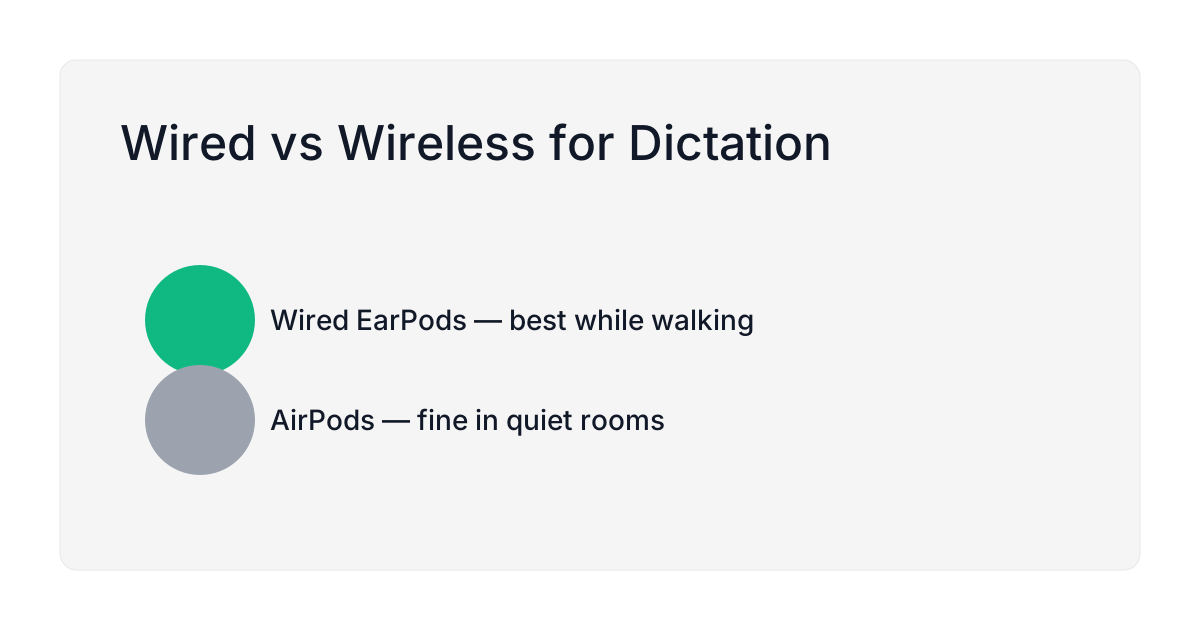
Here is the short answer for busy people.
- Cleanest while moving: wired EarPods with Lightning or USB C.
- Comfortable at a desk: AirPods in a quiet room.
Now the longer answer you will be glad you read once.
What goes wrong outdoors
The failure is not a transcript full of nonsense. It is a transcript that reads fine until one gusty stretch, where a handful of short words come back as different short words. You do not notice while speaking, and later you cannot tell which lines you can trust. A note you have to re-verify is worse than no note.
We have not published a controlled recording of this comparison yet, so treat the guidance below as mechanism plus the test you can run yourself in ten minutes. If your route is calm, your result may differ from ours.
Why this tiny choice matters
Bluetooth is a miracle. It is also a negotiator. The moment you start recording, AirPods switch from the high-bitrate profile used for music playback to a low-bitrate, bidirectional call profile, because Bluetooth cannot send high-quality audio in one direction and take a microphone feed in the other at the same time. That call profile caps the mic at a narrow sampling rate, well below what a wired connection carries, and the missing high frequencies are exactly where consonants live. Wired mics do not switch profiles. They sit still near your mouth and keep the same signal path throughout.
If you never leave your desk, you may never notice. If you write while walking through air that moves, you will.
The 60 second rule
Use wired EarPods when you move. Keep the mic 15 to 25 cm from your mouth. Turn your face away from the wind. That is it.
If you are at a desk in a soft room, AirPods are fine. Keep your chin steady. Talk toward the mic. Do not spin in your chair.
Quick test you can run today
Pick one paragraph you know by heart. Read it twice while walking. First with AirPods. Then with wired EarPods. Read it once at your desk with AirPods. Count edits. Keep the setup that needs fewer fixes. Do not guess. Test once. Decide for months.
Frequently asked questions
Are AirPods useless outside. No. They are fine on a calm day in a quiet street. They are also fine for short captures where a tiny accuracy hit is worth the comfort.
What about AirPods Pro with noise canceling. Canceling is for your ears. The mic still hears the world. Wind can still push it around.
Do I need a fancy lav mic. If you record a lot while moving, a small wired lav near your collarbone is great. For most people the free EarPods are enough.
What if my phone has no headphone jack. Use the Lightning or USB C EarPods that Apple currently ships. They plug into the port.
Field craft for clean capture
- Hold the phone a half forearm from your mouth.
- Turn your body so the mic faces away from traffic or fans.
- If a truck passes, pause for two seconds. Start again with a clean sentence.
- If wind picks up, use your jacket collar as a shield without covering the mic.
A talk track you can steal
Title. Ticket flow friction.
New users open Reports to a blank screen and bail.
We can show an explainer and a Create first report button.
I will ship copy and a placeholder image by Friday.
Emotion. focused.
That is the whole format. Yours can be shorter. The point is to keep the audio even and the sentences simple. The mic will thank you.
Where to go next
If you often record outside, read the short guide on mic positioning. If you want steps that work indoors and out, try the dictation tips. If you ever wonder whether you could keep writing on a plane, see offline capture.
Bottom line. Choose the tool that fits the air you are in. Wired for motion. Wireless for quiet.